| THE HISTORY OF THE SZÁRAZ-RUDNYÁNSZYKY
CASTLE
The history of the castle stretches back to Antiquity and is almost
analogous with the history of Hungary. From around 10
B.C. the eastern frontier of the Roman Empire stretched along
the west
bank of the Danube, where a chain of fortifications was built
against incursions by the barbarian peoples beyond the river.
Known at that time as Campona, Nagytétény formed a part of this
chain. On the site of today's castle a
farmhouse (villa rustica) then stood.
On the remains of this building a fortified
Gothic castle was constructed in the 13th century by the Tétény
family, who were
local landowners. This castle forms the core of the present building.
Room 3 on the ground floor of the Danube wing dates from this
period.
Around 1309 Tétény passed into the ownership
of Lőrinc Hédervári, palatine and commander of Buda Castle. The
family owned it for
more than two centuries. During the time of the Héderváris
the existing wing was extended through the addition of Rooms
1 and
2 on the ground floor and Room 13 above.
During the approximately
150 years of the Turkish occupation (1541-1686) Tétény belonged
to the Sanjak of Buda, which was
under the direct control of the sultan. Following the expulsion of the Turks the building,
now in ruins, was given to the Austrian commander Ferenc Buchingen,
in recognition
of his military services. Ferenc Buchingen sold it to László
Petrovay. Afterwards the property, now mortgaged, was acquired
from the widowed Mrs. Petrovay (née Julianna Daróczy) by György
Száraz, her future brother-in-law.
Chief Justice György Száraz,
who was raised to the rank of baron, began farming in Tétény
in 1716 and set about rebuilding the
castle. Baron György constructed a vaulted stable building
parallel to the southern wall of the castle. This was later incorporated
into the castle as living accommodation. Presently Room 10,
this
is the last ground-floor room of the Danube wing.
After György Száraz's
early death (1733), his son-in-law József Rudnyánszky - a nephew
of the powerful
Antal Grassalkovich, a
patron of the arts - continued the reconstruction work, but
to a new plan. It is with him that the fashioning of the aristocratic
Baroque residence (1778) is associated. The building is one
of
a number of so-called Grassalkovich castles in Hungary.
No creditable data exists
concerning the identity of the man who designed the new building,
but
obvious stylistic similarities
between the Nagytétény and other Grassalkovich castles -
including the one at Gödöllő - point to a common architect.
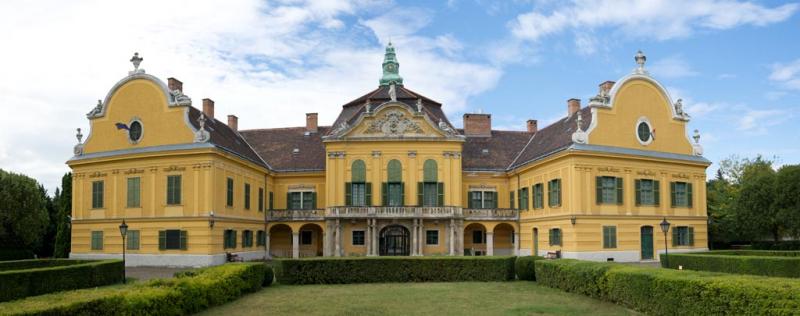
Owing to the reconstruction carried out
in József Rudnyánszky's time, the castle became an aristocratic
Baroque residence:
the stable block, now with an upper storey added, was now
connected to the edifice constituting the castle's core by
a two-level
east wing and a two-level west wing.
next >>
|