Back to Home Page Home pageEnglishinfo@nagytetenyi.hu
 
InformationsServicesLatest NewsHistoryPermanent ExhibitionFurnituresPublicationsArchiveSupportersLink
History
Lady by a piano - mural in a room on the first floor, al secco, 2nd half of the 18th c., painter unknown


Figural scene in chinoiserie style - mural in a room on the first floor, al secco, 2nd half of the 18th c., painter unknown

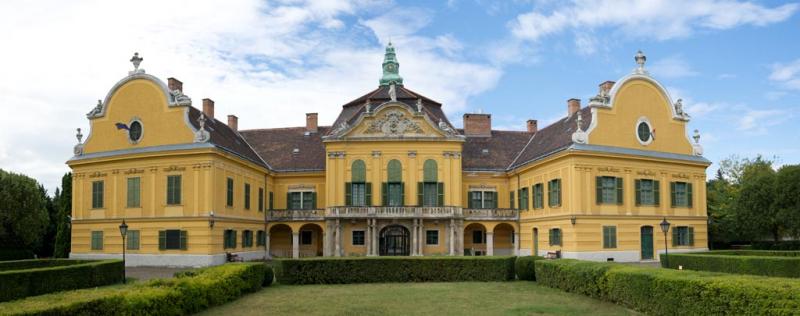
The main facade was built on the French model. Between wings jutting out on both sides there is a cour d'honneur, closed on three sides. The middle projection standing out from the plane of the facade includes the main staircase and the ceremonial hall, which is two levels in height. The main facade of the castle is made still more atmospheric by a roof suggestive of a cupula, by a balcony and by sculptural ornamentation: on the gable can be seen the coat of arms of the Száraz-Rudnyánszky family. The figures on the ledges symbolize the passage and the renewing effects of time: there are figures representing the Four Seasons and figures of Day and Night, as well as a clock. The castle's facade is a little theatrical, and is made rendered still more dynamic by ledges, pilasters, columns, and niches all providing light-and-shade effects.

Originally the walls of the rooms were embellished with murals painted using the al secco technique. With the exception of one ceiling, these have survived only on the upper floor. The murals were probably not executed all at one time; the names of the artists are unknown.

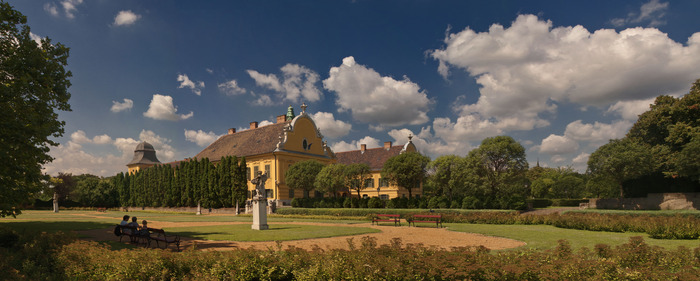
The castle park with its three-part terrace extends to the towpath running along the Danube bank. Sources from the time mention a pheasant garden and unusual flora.

After the death of Mrs. Rudnyánszky, née Julianna Száraz (1798) the castle was inherited by collateral relations. The central wing passed to Zsigmond Horváth de Szentgyörgy, member of the royal bodyguard and a counsellor at Court. When the family was raised to the rank of counts, it took the name Hugonnay. Vilma Hugonnay, Hungary's first woman doctor, was born within the walls of the castle in 1847.

The precursor of the Convalescent Home still operating in the south-west wing of the castle, an orphanage run by the Vincentian sisters, was established by Stephanie Heuze, one of the heirs.

Having been rebuilt at the end of the 18th century, the castle was altered in the 19th. In 1904 it was partly gutted by fire. Of the original furniture and fittings nothing remains.

After the Second World War, in which it suffered serious damage, the building was taken over by the Hungarian state. In the summer of 1948 a furniture exhibition assembled from items belonging to the Budapest Museum of Applied Arts opened in the building. On account of its deteriorating condition, the castle, which had become known as the furniture museum, closed in 1989.

On completion of renovation work begun in 1997 the Nagytétény Castle Museum opened its doors again in June 2000 with its exhibition entitled "The Art of Furniture-Making from the Gothic to the Biedermeier".

<< previous